R.test
At Riiid, I helped bring AI based SAT prediction and diagnosis to U.S. learners. R.test Mini offered a shorter diagnostic experience (about 40 minutes), but score prediction alone could not show whether students became better problem solvers.
Diagnostic assessment and learning experience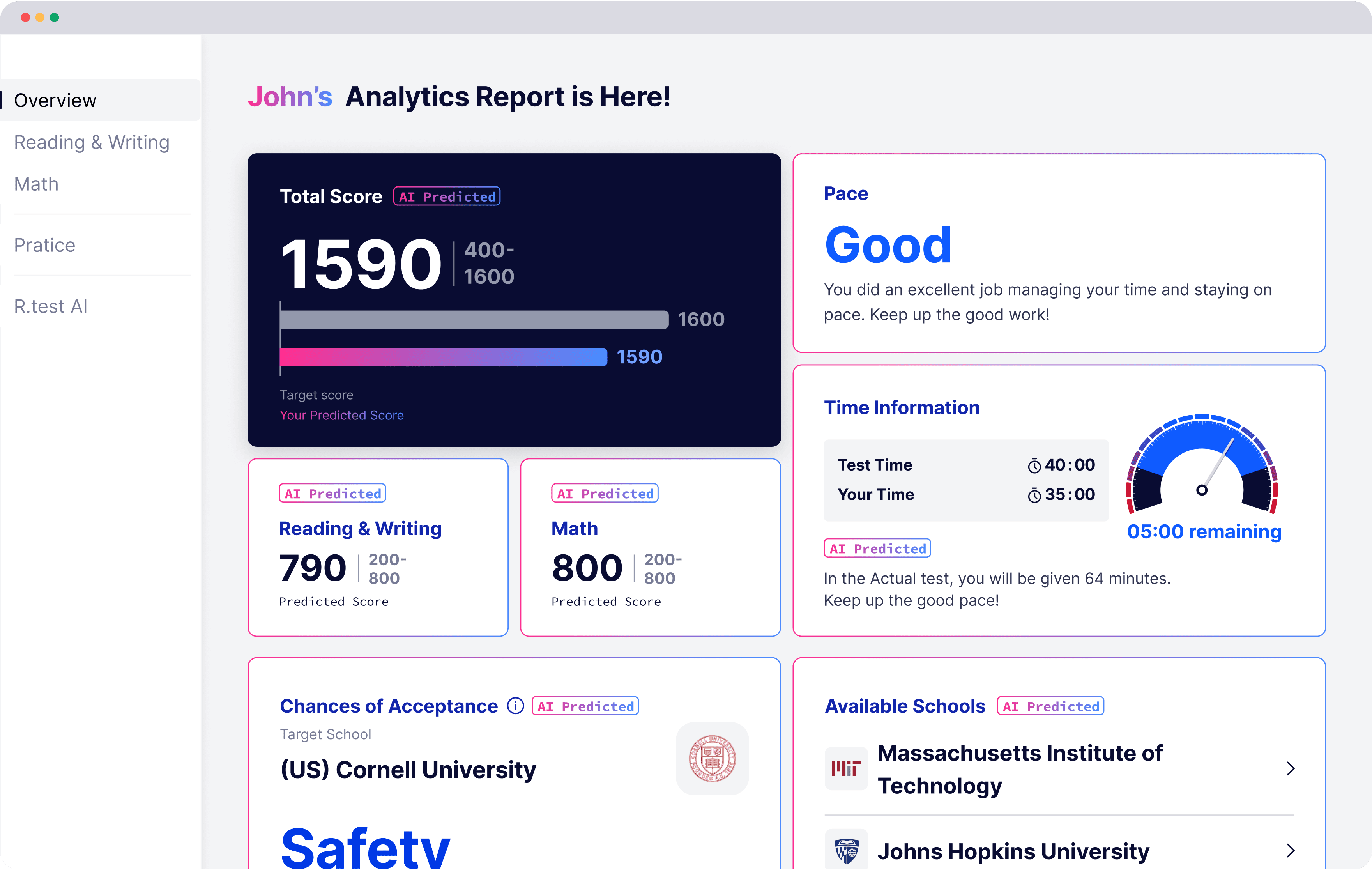
Can an AI assessment help students become better problem solvers, rather than simply measure how well they perform?
My work & approach
- Worked on product management for AI assessment experiences, including R.test and related learning products.
- Connected user needs, testing experiences, product strategy and learning oriented feedback.
- Explored assessment as a learning experience rather than merely an output score.
What I took forward
An efficient test can predict performance; a useful learning agent may need to withhold a solution and invite the learner to think. This motivates my interest in measuring capability after AI assistance.
Connection to my research direction
Socratic scaffolding is one form of selective intervention: when the system already knows an answer, asking a question may better preserve human growth.
A second pilot across product, design, engineering, AI research, and data science examined SAT tutor onboarding, bias, and explanations. Participants valued a shared framework while noting ambiguous examples and limited discussion time. These are design proposals and pilot observations, not verified shipped features or measured learning gains.
A separate Socratic questioning proof of concept guided students who answered SAT questions incorrectly through intermediate questions instead of immediately revealing an answer. It did not establish learning gains.
Explore the source
← Back to all projectsHow I opened a path to real classroom feedback
- When U.S. high schools wanted validation from another school before trying R.test, I independently researched approximately 1,000 teachers and sent personalized outreach. One teacher tested the product with students and introduced me to other teachers. This created our first U.S. classroom feedback channel.
- I asked whether a faster diagnostic really helps learners build the skills being assessed. I ran a Socratic questioning proof of concept that guided students after incorrect answers rather than immediately revealing solutions. It was an exploratory prototype, not a measured learning improvement.
- I shared weekly user pain points with the development team and convened product, design, engineering, AI research and data science colleagues to apply a Human AI Interaction workbook I adapted from Microsoft guidelines. The workshops informed recommendations on score explanations and assessment choices.
What I learned: independent outreach can create the evidence a product needs, and a successful prediction does not by itself establish learning.